
Sixty-Four Squares, One War: Legends, Rivalries, and the Story of Chess
“Chess is the gymnasium of the mind”
Chess history lives in the silence before a move. Two players sit across a board no wider than a dinner tray. A clock ticks. Spectators hardly breathe. One player reaches for a piece, pauses, and withdraws the hand. Behind that hesitation stand more than fifteen centuries of experiments, empires, manuscripts, champions, arguments, machines, and unforgettable rivalries.
That is what makes chess different. The board is small, but the story around it is enormous. Chess history is not merely a sequence of famous names or beautiful combinations; it is the story of how cultures repeatedly inherited the same strategic idea and reshaped it for their own age. From an Indian war game to Persian courts, from medieval Europe to Paris cafés, from Cold War Reykjavík to online arenas watched by millions, the game has changed without losing its central drama.
This is the war of sixty-four squares: quiet, intellectual, intensely personal. What follows is a journey through chess history—its real origins, persistent myths, evolving rules, legendary rivalries, political symbolism, computer revolution, modern boom, and continuing cultural power.
Table of Contents
- What Is Chess? A Quick Primer
- Where Chess Began — The Real Origins
- Chess History: Myths vs. Facts
- From Persia to Europe — How Chess Spread
- The Rule Changes That Created Modern Chess
- Chess Becomes Organized — Clubs, Theory, and Competition
- The Golden Age of Rivalries
- The Cold War Era — Chess as Geopolitics
- The Computer Era — Man vs. Machine
- The Modern Era — Carlsen, Streaming, and the Online Boom
- Chess in Culture — Beyond the Board
- Why Chess Still Matters
- Closing Reflection
1. What Is Chess? A Quick Primer
Chess is a two-player strategy game played on an eight-by-eight board: sixty-four alternating squares, sixteen pieces per side, and one king whose survival determines everything. Each army begins with a king, a queen, two rooks, two bishops, two knights, and eight pawns. The pieces move in different ways, and that asymmetry creates the game’s endless strategic possibilities.
The objective is checkmate: to attack the opposing king so that no legal move can remove the threat. Capturing pieces matters, but material is only a means. A player can be ahead by a queen and still lose if the king is trapped. That tension between visible resources and invisible danger is one reason chess history is filled with sacrifices that appear irrational until the final move explains them.
A game may be decided by tactics — a fork, pin, skewer, discovered attack, or mating combination — or by strategy built slowly through space, pawn structure, weak squares, piece activity, and king safety. Modern tournament chess adds clocks, time controls, notation, ratings, and formal rules, but the essential contest remains direct: one mind proposes an idea, the other tries to refute it.
Chess is therefore best understood as a war of ideas played in silence. There is no physical contact and usually no spoken argument, yet every move asks a question: What do you threaten? What do you fear? What are you willing to give up?
2. Where Chess Began — The Real Origins of Chess History
The strongest historical consensus traces the principal ancestor of modern chess to chaturanga, a game that flourished in India by the 6th century CE. Earlier dates are sometimes proposed, but clear references become much firmer in the 6th century, which is why responsible accounts of chess history usually begin there rather than claiming a precise inventor or a much older undocumented origin.
Chaturanga reflected the traditional divisions of an army. Its forces included infantry, cavalry, elephants, and chariots — ancestors of today’s pawns, knights, bishops, and rooks — alongside a king and counselor. The game was played on an eight-by-eight board, and unlike games in which pieces have identical powers, these military units had distinct functions. That combination of unequal movement and a royal piece whose fate decided the battle became part of chess history’s permanent DNA.
From India, the game moved into Sasanian Persia, where it became chatrang and then, in the Arabic-speaking world, shatranj. Persian terminology left a mark that survives in English. “Check” ultimately comes through words related to shah, meaning king, while “checkmate” developed from shah mat. The exact nuance of mat has been debated — renderings include “helpless,” “stumped,” “frozen,” or, through Arabic interpretation, “dead” — but the strategic meaning is unmistakable: the king can no longer escape.
The Persian chapter is especially important because it shows how chess history traveled through cultural exchange rather than a single act of invention. Stories in Persian literature describe chess arriving from India, while surviving texts and pieces reveal a game already embedded in courtly life.
For a deeper look at the game’s journey across centuries, Wikipedia’s History of Chess provides a broad historical timeline, while Chess.com’s complete history of chess offers a more accessible overview. For the Persian chapter in particular, the Metropolitan Museum of Art explores the cultural background of Shah Mat and medieval chess.
3. Chess History: Myths vs. Facts
Few old games attract as many neat origin stories as chess. The problem is that neat stories are often easier to remember than messy evidence. A serious account of chess history therefore has to separate folklore from what historians can actually support.
Myth: Chess was invented by one genius, king, or philosopher
Fact: There is no securely documented single inventor. Chess developed over time, most likely from earlier Indian board-game traditions, before evolving in Persia and later regions. Naming one person may make a satisfying legend, but it oversimplifies chess history.
Myth: The wheat-and-chessboard story is a documented historical event
Fact: The famous tale says the inventor asked a ruler for one grain of wheat on the first square, two on the second, four on the third, and so on, doubling across all sixty-four squares. The result is an enormous exponential total. It is a brilliant mathematical parable, but not reliable evidence about the actual invention of chess. In chess history it belongs to folklore, not biography.
Myth: Chess has always used the same rules
Fact: Early chess was much slower. The piece that became the queen was comparatively weak, and the ancestor of the bishop had limited movement. In late-15th-century Europe, the queen gained her sweeping modern power and the bishop acquired its long diagonal range. The transformation accelerated play so dramatically that historians often treat it as the birth of modern chess. A documented game from Valencia in 1475 is among the earliest surviving examples using the modern queen and bishop moves.
Myth: Chess is pure logic and therefore separate from politics
Fact: The moves themselves obey neutral rules; the institutions around them do not exist outside society. Monarchs used chess as a courtly symbol, nations invested in elite players, and governments sometimes treated victories as evidence of prestige. The Cold War made that connection especially visible, although it is important not to pretend every move by a Soviet or American player was a political act.
Correcting these myths makes chess history more interesting, not less. The real story is not a miracle invention frozen in time. It is a centuries-long process of adaptation.
4. From Persia to Europe — How Chess Spread
After the Arab conquest of the Sasanian Empire in the 7th century, shatranj entered the wider Islamic world. From there, players, merchants, scholars, diplomats, soldiers, and courts helped carry the game across a vast geographic network. Chess became known from Central Asia and Persia to Baghdad, North Africa, and the Iberian Peninsula.
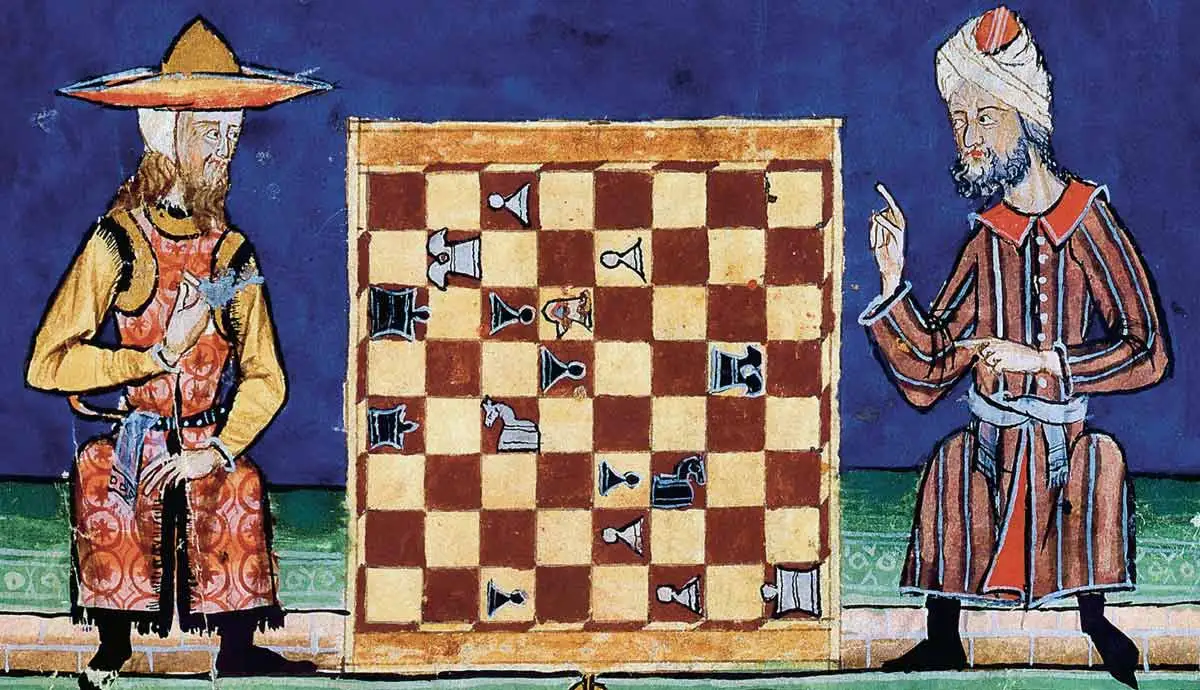
This stage of chess history matters because the Islamic world was not simply a bridge between India and Europe. In this phase, chess history becomes a story of scholarship and adaptation as much as geographic movement. Medieval Islamic pieces were often abstract rather than naturalistic, and surviving examples show that chess was both a game and an object of craftsmanship. The Metropolitan Museum notes that chess reached Spain from Islamic lands and became popular among Muslims, Jews, and Christians, especially in courtly settings.
By around the turn of the first millennium, chess was increasingly visible in Europe. Muslim Spain, or Al-Andalus, was one major route; Mediterranean exchange, Sicily, and Byzantine connections also played roles in transmission. European cultures then reinterpreted the pieces through familiar social structures. The king remained the king. The counselor became a queen. The elephant was transformed in some regions into a bishop. Horsemen became knights, while the rook preserved a more complicated linguistic ancestry linked to the Persian rukh.
The result was cultural translation on a board. Chess history shows the same underlying game wearing different political, religious, and artistic clothing as it moved from society to society. For a readable complementary account, see Just History Posts’ brief history of chess.
5. The Rule Changes That Created Modern Chess
If a player from the early shatranj era sat down against a modern grandmaster, the board might look familiar—but the game would not feel the same. The decisive revolution came in Europe near the end of the 15th century, particularly in the chess cultures of Spain and Italy.
The most dramatic change was the queen. Her predecessor could move only a short distance, making her one of the least mobile major pieces. Under the new rules, the queen could race across ranks, files, and diagonals. The bishop also gained its unlimited diagonal movement. Suddenly attacks could travel from one side of the board to the other in a single move. Openings became more dangerous, king safety more urgent, and tactical combinations more explosive.
This chapter of chess history is sometimes called “Mad Queen chess,” a name that captures how radical the new piece felt to players used to slower forms. The exact path of the reforms is not reducible to one date or one city, but the 1490s are a key period, and the 1475 Valencian poem Scachs d’amor records a game with the modern queen and bishop powers.
Other rules continued to settle over time. Forms of castling developed and were gradually standardized, while en passant and the pawn’s initial two-square move became part of the modern system. By the 16th and 17th centuries, chess increasingly resembled the game a tournament player would recognize today.
The significance is difficult to overstate. This turning point in chess history transformed the pace of play. Chess history did not preserve itself by refusing change. It survived partly because its rules changed enough to make the game faster, sharper, and richer while preserving the same central objective: trap the king.
6. Chess Becomes Organized — Clubs, Theory, and Competition
By the 18th century, European coffeehouses had become important chess centers. London and Paris in particular produced famous meeting places where strong players could find opponents, spectators, patrons, and reputations. Paris’s Café de la Régence became associated with generations of masters, while British club culture helped turn chess into a more organized competitive activity.
Theory also matured. François-André Danican Philidor’s 1749 Analyse du jeu des Échecs shifted attention toward positional ideas and pawn play. His most famous principle survives in a compact line:
“The pawns are the soul of chess.” — François-André Danican Philidor
That idea marks an important change in chess history. The game was not only about immediate combinations; it could be studied systematically. Printed books and magazines made it possible to preserve analysis, compare openings, and debate strategic principles across borders. Notation gave players a shared written language for recording games, allowing one generation to learn directly from another.
By this point, chess history was becoming increasingly documented rather than merely remembered. The 19th century brought formal international competition. London 1851 is widely recognized as the first international chess tournament, organized largely through the efforts of Howard Staunton and won by Adolf Anderssen. It created a model for elite events and helped establish the idea that the strongest players could be tested in a single organized competition.
In 1886 Wilhelm Steinitz defeated Johannes Zukertort in a match played across New York, St. Louis, and New Orleans. That match is recognized as the first official World Chess Championship, making Steinitz the first official world champion. The institutional side of chess history would grow further with the founding of FIDE in Paris in 1924.
7. The Golden Age of Rivalries
Championships give chess a structure; rivalries give it memory. For many readers, chess history becomes most vivid when two great players repeatedly collide. The greatest rivalries were never only about results. They offered competing styles, personalities, generations, and ideas about how the game should be played.
José Raúl Capablanca and Alexander Alekhine brought one of the earliest great championship contrasts. Capablanca, the Cuban champion, was famous for clarity, endgame technique, and an almost effortless style. Alekhine brought dynamic preparation and attacking imagination. When Alekhine defeated Capablanca in Buenos Aires in 1927, the title changed hands—and the absence of a rematch became part of the rivalry’s mythology.
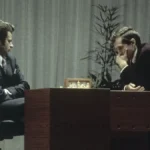
Bobby Fischer and Boris Spassky turned a championship match into an international spectacle in 1972. Fischer’s individualistic American image collided with Spassky’s position within the powerful Soviet chess system. Their games would be studied for decades, but their rivalry became larger than the board because the world around them insisted on reading geopolitical meaning into it.
Then came Anatoly Karpov and Garry Kasparov, perhaps the defining rivalry of modern chess history. Their first world championship match in 1984 stretched to 48 games before being stopped without a winner. Kasparov took the title in their 1985 rematch, and the two continued to meet in championship battles through 1990. Karpov’s positional restraint and Kasparov’s energy became shorthand for two contrasting approaches to elite chess.
8. The Cold War Era — Chess as Geopolitics
The Soviet Union treated chess seriously and built an extraordinary competitive system around coaching, clubs, analysis, and state-supported sporting structures. From Mikhail Botvinnik’s world title in 1948 until Fischer’s victory in 1972, every undisputed world champion was Soviet. That dominance made chess one of the arenas in which Soviet intellectual and sporting prestige could be displayed.
In chess history, the most famous rupture came in Reykjavík. The 1972 World Championship between Boris Spassky and Bobby Fischer was undeniably played against a Cold War backdrop. Western journalists often framed Fischer as a lone American challenging a Soviet machine, while Soviet officials faced pressure to protect a title their players had controlled for decades. Still, the match should not be reduced to a simple government-versus-government script: Fischer was famously difficult for American institutions too, and Spassky was an individual competitor, not a political symbol with no agency.
The drama only intensified the symbolism. Fischer delayed his arrival, objected to conditions, lost the first game, and forfeited the second. Then he returned, won Game 3—his first career victory over Spassky—and eventually captured the match 12½–8½. The result ended twenty-four years of uninterrupted Soviet possession of the world title.
For readers who want to revisit the match in more detail, Chess.com’s Match of the Century breaks down the Fischer–Spassky showdown and its defining moments. Reykjavík endures because it was both a remarkable world championship match and a contest the world inevitably viewed through the tensions of the Cold War.
9. The Computer Era — Man vs. Machine
For centuries, chess history was a record of humans learning from humans. The computer era made chess history a record of humans learning from machines as well.
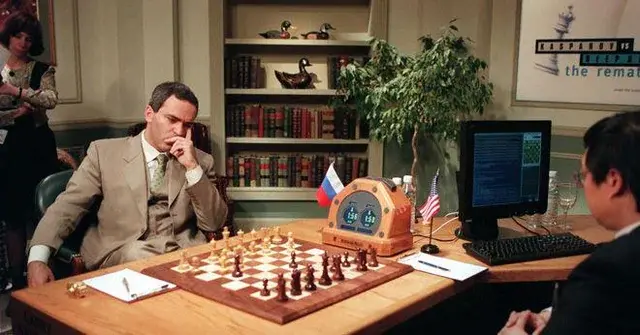
The most famous turning point arrived in 1997. Garry Kasparov, then the dominant symbol of human chess excellence, faced IBM’s Deep Blue in a six-game rematch. Kasparov had defeated an earlier version in a 1996 match. In 1997, however, Deep Blue won 3½–2½. The final game ended after only 19 moves when Kasparov resigned.
The event mattered far beyond competitive chess because it became a public symbol of machine calculation challenging a field associated with human intelligence. HISTORY’s account of Deep Blue defeating Garry Kasparov captures how startling the result appeared at the time. Kasparov’s own summary of his state in the decisive game was painfully concise:
“I lost my fighting spirit.” — Garry Kasparov
Yet the deeper consequence of computers was not that machines “killed” chess. They became its most powerful training partners. Engines could test opening ideas, expose tactical errors, evaluate endgames, and search positions at a depth no human team could reproduce manually. Databases allowed players to prepare against an opponent’s entire recorded career. Analysis that once required teams of grandmasters could begin on a laptop.
Stockfish later became a dominant conventional engine, while neural-network systems such as AlphaZero and Leela Chess Zero encouraged fresh discussion about machine style and strategic creativity. Modern professionals now train in a hybrid world: human judgment chooses questions; machines relentlessly test answers.
That reversal may be one of the most important lessons in chess history. The machine that seemed to threaten the game ultimately deepened the way humans study it.
10. The Modern Era in Chess History — Carlsen, Streaming, and the Online Boom
Magnus Carlsen became world champion in 2013 and held the classical crown for nearly a decade, defending it four times before choosing not to defend again after his 2021 victory over Ian Nepomniachtchi. His decision did not mean decline. Carlsen has remained one of the central figures in elite chess, and FIDE continues to list him as the world’s top-rated player. His peak classical rating of 2882 remains the highest recorded.
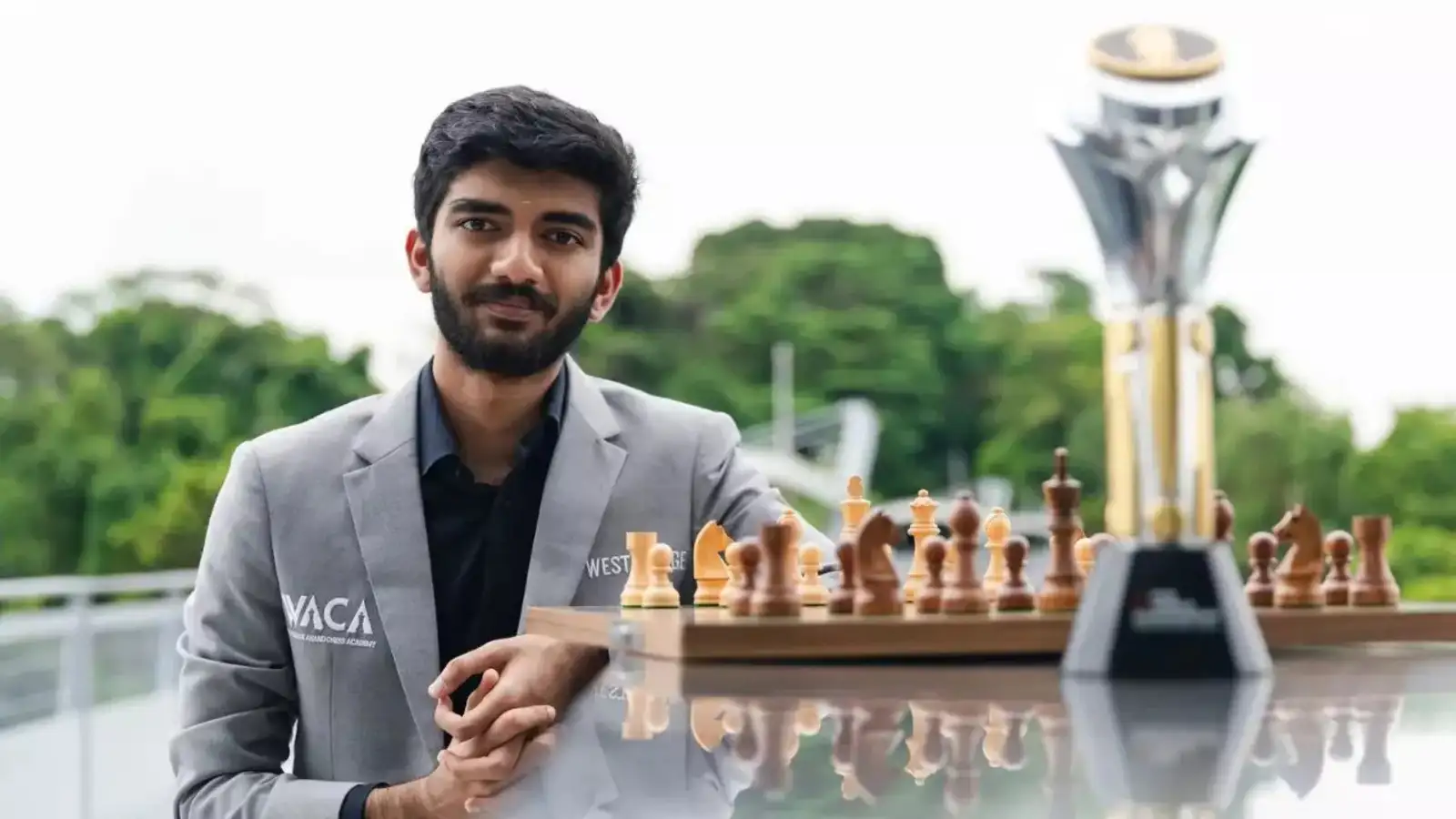
The classical title, however, moved on. Ding Liren won the vacant championship in 2023 after defeating Nepomniachtchi in rapid tiebreaks. In 2024, 18-year-old Gukesh D defeated Ding 7½–6½ in Singapore to become the youngest world champion in chess history.
As of September 2026, Gukesh is the reigning FIDE World Champion, and Javokhir Sindarov—winner of the 2026 Candidates Tournament—is his designated challenger. FIDE states that the dates and host city for their 2026 World Championship Match are still to be announced.
At the same time, chess moved far beyond the boundaries of traditional tournament halls. Platforms such as Chess.com and Lichess made the game accessible around the clock, allowing players to find opponents instantly, solve puzzles, follow live broadcasts, study databases, and analyze their games with powerful engines. Lichess alone reports that more than five million games are played on its platform each day, highlighting the enormous scale of modern online chess. More details about the platform and its global community are available on Lichess’s official overview.
Streaming changed the relationship between elite players and fans. Hikaru Nakamura became one of the defining personalities of the online era, while creators such as GothamChess helped make instructional and entertainment content accessible to audiences far beyond traditional tournament followers.
Then came The Queen’s Gambit in 2020. Netflix reported that a record 62 million households chose to watch the limited series in its first 28 days. Netflix also reported that the number of new players on Chess.com increased fivefold during the surrounding surge in interest. Pandemic lockdowns had already pushed people toward online play, so no single cause explains the boom, but the series clearly became a major cultural accelerator.
Modern chess history also proved that controversy could command mainstream attention. In September 2022, Hans Niemann defeated Carlsen at the Sinquefield Cup; Carlsen withdrew from the event, and public cheating allegations followed. Niemann later filed a $100 million lawsuit against Carlsen, Chess.com and others. A federal judge dismissed the case in June 2023, and the parties announced an agreement that August, with Niemann returning to Chess.com.
Carlsen once captured chess’s strange durability in a sentence:
“Chess has been around for a long time, and it’s still far from being figured out by us humans.”
That may be the best summary of this phase of chess history: ancient game, new infrastructure.
11. Chess in Culture — Beyond the Board
Chess has always been easier to use as a metaphor than most sports. A chessboard instantly suggests calculation, conflict, hierarchy, sacrifice, foresight, and hidden intention. That is why it appears so frequently in novels, paintings, films, advertisements, music videos, political cartoons, and conversations that have nothing to do with actual tournament play.
The cultural side of chess history has created familiar character types: the lonely genius, the child prodigy, the obsessive analyst, the cold strategist, the eccentric champion. Some reflect real personalities; others flatten complicated people into convenient myths. Bobby Fischer, for example, is often presented as the ultimate isolated genius, while Carlsen has been marketed as a modern, globally recognizable champion. The truth of elite chess is usually less romantic: talent matters, but so do coaching, study, preparation, resilience, opportunity, and years of deliberate practice.
Film and television have repeatedly used chess as visual shorthand for intelligence. The Queen’s Gambit succeeded partly because it did something more difficult: it made the games themselves dramatic enough for viewers who could not necessarily calculate the positions. That widened the cultural audience for chess and revived interest in the aesthetics of boards, clocks, notation, and tournament halls.
Anatoly Karpov’s often-quoted description expresses why the game crosses categories so easily:
“Chess is everything—art, science, and sport.”
Whether one accepts “everything” literally is beside the point. Chess history sits unusually comfortably across all three worlds. A combination can be beautiful, an opening can be researched, and a championship can be fought under sporting rules.
That cultural reach also explains why celebrity players fascinate audiences. Actors, musicians, athletes, politicians, writers, and entrepreneurs have all used chess recreationally or publicly, creating a natural bridge to a future feature on celebrities who play chess.
12. Why Chess Still Matters
The simplest reason chess still matters is accessibility. A physical board is inexpensive, digital boards can be free, and two people who do not share a spoken language can still understand the same legal moves. Once the rules are learned, a player can sit down almost anywhere in the world and participate in the same game.
Education is another reason, although claims should be made carefully. Chess is often promoted as a way to improve concentration, planning, calculation, and academic performance. Research is promising in some areas but not magical. A 2016 meta-analysis found a modest overall effect across academic and cognitive measures, while also warning that limitations in study design made it difficult to rule out placebo effects and other influences. Chess can therefore be a useful educational activity without needing exaggerated claims that it automatically raises intelligence.
The game also teaches a practical discipline: decisions have consequences. You cannot blame a referee for a blunder you made with your own hand. You learn to review mistakes, compare alternatives, manage time, and continue after losing. Those habits help explain why schools, clubs, community programs, and online learning platforms repeatedly find uses for chess.
Most importantly, chess history is not finished. The living nature of chess history is one reason a game with medieval roots continues to attract new players. Every generation inherits a complete set of rules but finds new openings, training methods, formats, personalities, and audiences. The board does not need redesigning to feel modern. The people around it keep changing the meaning of the game.
13. Closing Reflection — One War, One Move at a Time
After more than 1,500 years, chess still begins with the same extraordinary compression: thirty-two pieces, sixty-four squares, two opponents, one first move. Everything else—empires, cafés, championships, propaganda, computers, streaming platforms, lawsuits, films, ratings, databases—exists around that central encounter.
That is why chess history feels both ancient and alive. The deepest appeal of chess history is this continuity across radically different eras. The pieces carry traces of armies and courts that no longer exist, yet a child opening an app today can confront the same essential problems that fascinated Persian scholars, European masters, Soviet champions, Fischer, Kasparov, Carlsen, and Gukesh. The vocabulary evolved. The queen became stronger. The clocks became faster. Engines became superhuman. The war of ideas survived.
There are many roads outward from this pillar: profiles of the greatest legends, detailed accounts of Capablanca–Alekhine and Karpov–Kasparov, the full story of Fischer–Spassky, guides to famous openings, tactical themes, historic games, computer chess, celebrity players, and the cultures that made the board their own.
For more sports history, analysis, tactics, stories, and guides, continue exploring The Sports Manual.
And for readers who want to follow new features as they are published, join The Sports Manual on Instagram, WhatsApp, LinkedIn, X, and Medium.