
Deep Blue vs. Kasparov: When a Machine Beat a Legend
On May 11, 1997, IBM’s Deep Blue defeated Garry Kasparov in New York and became the first computer to beat a reigning world chess champion in a full match under standard tournament time controls. The final score was 3½–2½, but the importance of the result extended far beyond six games of chess.
Kasparov was not simply another grandmaster. He was the world’s top-rated player and had been world champion since 1985. Deep Blue, meanwhile, represented years of work in computer chess, specialized hardware, parallel processing and human-designed chess knowledge. Their match brought competitive sport, corporate technology and artificial intelligence into the same international story.
For many people outside computer science, this was one of the first occasions when the question of machines surpassing human expertise felt immediate rather than theoretical. Yet Deep Blue was also very different from the machine-learning systems now associated with artificial intelligence. It relied heavily on extraordinary search speed, carefully designed evaluation rules and specialist chess knowledge.
The story of Deep Blue vs. Kasparov is therefore not only about who won. It is about how the machine was built, why Kasparov was such a difficult opponent, what happened in the controversial six-game rematch, and why the result continues to appear whenever technology crosses another boundary once thought to belong to humans.
For the wider historical setting, The Sports Manual’s history of chess and its legends follows the game from its ancient origins through the computer era and modern online chess.
Table of Contents
- The Scene — May 11, 1997
- Garry Kasparov Before Deep Blue
- What Was Deep Blue?
- How Deep Blue Actually Worked
- The 1996 Match — The First Warning
- Preparing for the 1997 Rematch
- Deep Blue vs. Kasparov — Game by Game
- The Final Result
- The Cheating Controversy
- Why IBM Retired Deep Blue
- Kasparov’s Reaction and Later Reflection
- How Deep Blue Changed Competitive Chess
- Where Deep Blue Is Today
- The Cultural Ripple Effects
- Why Deep Blue vs. Kasparov Still Matters
- Closing Reflection
1. The Scene — May 11, 1997
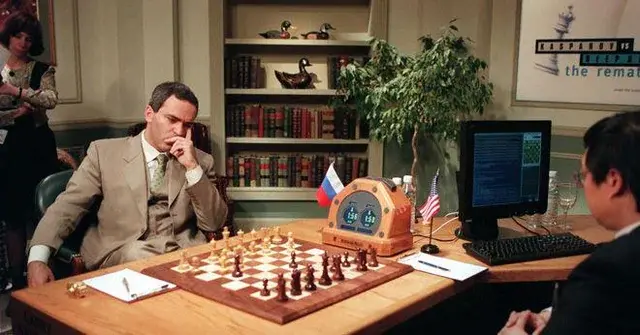
The final game was played in a specially arranged television setting at New York’s Equitable Center. Deep Blue and Kasparov entered Game 6 level at 2½–2½, so one result would decide the match.
It did not take long.
Kasparov chose the Caro-Kann Defence and played 7…h6, entering a position in which Deep Blue answered with the aggressive 8.Nxe6, sacrificing a knight to damage Black’s position and seize the initiative. Kasparov never recovered comfortably. After only 19 moves, he resigned.
A match that had been expected to produce another long struggle ended in roughly an hour.
The Computer History Museum records that Deep Blue won two games, Kasparov won one, and three were drawn. A sold-out audience of around 600 watched the games on screens in a theater below the television studio. Computer History Museum’s 1997 timeline
Kasparov later summarized his condition in the final game with a sentence that became inseparable from the match:
“I lost my fighting spirit.” — Garry Kasparov
The remark matters because the 1997 contest was not decided by processing power alone. Psychology became part of the story. Deep Blue could not become tired, angry or intimidated. Kasparov could, and the uncertainty created by several of the machine’s moves increasingly affected the way he approached the match.
2. Garry Kasparov Before Deep Blue
The importance of Deep Blue’s victory depends partly on understanding the player sitting across from it.
Kasparov became the youngest world chess champion in history in 1985 when, at 22, he defeated Anatoly Karpov 13–11. The two had already contested the extraordinary 48-game championship of 1984–85, which had been stopped without a winner. Their subsequent matches became one of the defining rivalries in chess.
Kasparov’s own official biography describes his rise to the world championship and notes that he would remain the game’s dominant rated player for much of the following two decades.
At the start of 1997, Kasparov was ranked No. 1 on the FIDE rating list at 2795, ahead of Viswanathan Anand and Karpov. By the July list, his rating had risen to 2820. Claims that he had spent one completely uninterrupted 12-year stretch at No. 1 oversimplify the rating record, but the broader point is clear: he entered the Deep Blue rematch as the leading player of his era.
Kasparov had also built his reputation on qualities computers were thought to struggle with. His preparation was deep, his calculation was exceptional, and his understanding of initiative and dynamic positions often allowed him to create complications that were difficult even for elite opponents.
Chess had produced globally famous championship stories before. The most obvious earlier example was Fischer vs. Spassky in 1972, when a world title match became part of the Cold War’s international narrative.
In 1997, the conflict was different. Kasparov was not representing humanity in any official sense, but the public framing made the symbolism difficult to avoid: the strongest human chess player against the strongest chess machine ever built.
3. What Was Deep Blue?
Deep Blue did not appear suddenly in an IBM laboratory in the 1990s. Its development can be traced back to Carnegie Mellon University and a project called ChipTest.
Feng-hsiung Hsu began working on computer chess at Carnegie Mellon in the mid-1980s. ChipTest used custom hardware to accelerate chess calculations, and its development eventually led to a stronger machine called Deep Thought. The Computer History Museum preserves the original ChipTest prototype and its history.
Deep Thought became strong enough to defeat grandmaster-level opposition, although Kasparov defeated it convincingly when they met in 1989.
IBM saw potential in the work. Hsu and Murray Campbell joined IBM Research, where the project expanded. A. Joseph Hoane Jr. later became an important member of the core technical team, particularly on parallel search. Other contributors included C. J. Tan and Jerry Brody.
Grandmaster Joel Benjamin supplied something equally important: high-level human chess expertise. His work helped the engineers test the system, improve its opening preparation and make its position evaluations more realistic.
The Computer History Museum’s archive identifies Joe Hoane, Joel Benjamin, Jerry Brody, Feng-hsiung Hsu, C. J. Tan and Murray Campbell among the IBM Deep Blue team.
The name itself reflected IBM’s identity. The company had long been nicknamed “Big Blue,” and Deep Blue became the chess-playing system designed to accomplish a simple but extremely difficult objective: defeat the world champion.
That objective also served IBM’s corporate interests. The company could demonstrate parallel computing through a contest that almost anyone could understand. A complex industrial calculation might be impressive to engineers, but a computer sitting opposite Garry Kasparov made technological progress visible to a global audience.
4. How Deep Blue Actually Worked
Descriptions of Deep Blue often reduce it to one phrase: brute force. That is partly accurate, but incomplete.
The 1997 system was built around IBM’s RS/6000 parallel-computing technology and used 480 specially designed chess chips distributed across 30 workstations. The machine could examine roughly 200 million chess positions every second. Smithsonian’s National Museum of American History documents the 30-workstation, 480-chip architecture, while the Computer History Museum preserves technical details about Deep Blue II.
The easiest way to understand this is to imagine a player considering possible moves and replies. A human grandmaster cannot calculate every legal continuation. Experience allows the player to ignore most possibilities and focus on lines that appear strategically important.
Deep Blue approached the problem differently. It could search an enormous number of possibilities very quickly, compare the resulting positions, and assign values to them.
But search speed alone was not enough.
The machine also needed a way to decide whether one position was better than another. Its evaluation system contained roughly 8,000 recognizable chess features or patterns. These included familiar concepts such as king safety, pawn structure, piece activity and other positional factors. The values were designed and tuned by the development team rather than discovered through modern neural-network training.
IBM Research’s technical paper on the Deep Blue system describes a combination of specialized chess hardware, parallel search, search extensions, a complex evaluation function and a database of grandmaster games.
This distinction is important.
Deep Blue did not learn chess in the way modern systems can train through enormous numbers of examples or self-play. It did not develop a neural network and discover its own abstract representation of chess. Human experts supplied much of its chess knowledge, and the machine’s main advantage was its ability to apply that knowledge while searching positions at extraordinary speed.
Murray Campbell later discussed the difference between Deep Blue and newer approaches in Scientific American’s retrospective on the match.
In other words, Deep Blue was highly specialized. It was exceptionally good at the problem it had been designed to solve, but defeating Kasparov did not mean IBM had created a general intelligence.
5. The 1996 Match — The First Warning
Kasparov and Deep Blue first met in Philadelphia from February 10 to 17, 1996.
The result ultimately favored Kasparov, but the opening game immediately changed the tone of computer chess.
Deep Blue won Game 1. That victory made it the first computer to defeat a reigning world chess champion in a game played under standard tournament conditions. It was only one game, but it demonstrated that a computer could now punish mistakes and sustain strong play against the best human opponent available.
Kasparov responded like a champion. He won Game 2, drew Games 3 and 4, and then won Games 5 and 6 to take the match 4–2. The final score appeared to restore the expected order: computers had become dangerous, but the best human player could still adjust, identify their limitations and win a multi-game contest.
A concise chronology is available in EBSCO’s history of Deep Blue’s matches with Kasparov.
For IBM, however, Game 1 was evidence that the gap had become manageable. Deep Blue did not need an entirely new concept. It needed more speed, stronger chess knowledge and better preparation.
The team spent the following year improving the machine.
What looked like a reassuring human victory in February 1996 was actually a warning.
6. Preparing for the 1997 Rematch
The rematch was scheduled for May 3–11, 1997, in New York.
IBM returned with a significantly stronger Deep Blue. The machine searched faster than the 1996 version, and the team had worked extensively on its evaluation system, opening knowledge and position understanding.
The event was also constructed as a major media occasion.
Computer chess had become a useful demonstration of technology because the contest required little explanation. Viewers did not need to understand processor architecture to understand the question: could the machine beat the champion?
The Computer History Museum notes that IBM supported the Deep Blue project partly to demonstrate its position as a leader in computing technology and to explore techniques that might have uses beyond chess. Its history of the Deep Blue project places the match within the wider development of artificial intelligence and high-performance computing.
That corporate dimension did not make the chess artificial. Kasparov still had to make every move over the board, and Deep Blue still had to produce moves strong enough to defeat him.
But it explains why the match attracted attention well beyond the chess press. IBM had created a sporting contest that also functioned as a global technology demonstration.
7. Deep Blue vs. Kasparov — Game by Game
Game 1: Kasparov takes control
The rematch began well for the world champion.
Kasparov gradually outplayed Deep Blue and won Game 1 in 45 moves. The result seemed to support the belief that, given time to understand the machine’s tendencies, a great human player could still exploit weaknesses that raw calculation could not solve.
Deep Blue was already enormously powerful, but it was not infallible. Kasparov led 1–0.
Game 2: The match changes
Game 2 became the most debated game of Deep Blue vs. Kasparov.
The machine produced several moves Kasparov considered surprisingly human in character. Rather than always choosing forcing tactical continuations, Deep Blue sometimes played quieter positional moves.
After 45.Ra6, Kasparov resigned.
That decision quickly became a major part of the controversy because later analysis showed that Black still had defensive resources. The exact evaluation has been debated, but the important historical point is that Kasparov did not need to resign when he did. Drawing chances remained.
The result levelled the match at 1–1, but its psychological effect may have been greater than the single point.
Kasparov became suspicious about how Deep Blue had produced some of its decisions. The machine had played in a way that did not fit his expectations of computer chess, and those doubts followed him through the rest of the match.
For readers who want to examine the moves directly, the 1997 game record and technical discussion at ChessProgramming.org provides the complete match sequence.
Games 3–5: Tension without a breakthrough
Game 3 was drawn after Kasparov deliberately moved away from conventional opening paths. The strategy reflected an important problem in playing a machine: standard opening theory could be programmed into its preparation, so unusual positions might force it to operate with less stored guidance.
Game 4 was another draw.
Game 5 also ended level, although neither player simply coasted toward the result.
After five games, Deep Blue and Kasparov were tied 2½–2½.
That meant Game 6 would decide the match.
Game 6: Nineteen moves
Kasparov chose the Caro-Kann Defence and played 7…h6.
The meaning of that decision has been debated ever since. One interpretation, associated with Deep Blue architect Feng-hsiung Hsu, is that Kasparov deliberately entered a line in which a strong piece sacrifice was available because he expected the computer to avoid it. Other analysts have treated the move more simply as an opening or move-order error.
Both interpretations should be kept in view because Kasparov’s exact intention cannot be reconstructed with complete certainty.
What happened next is clear.
Deep Blue played 8.Nxe6.
The knight sacrifice damaged Kasparov’s position and gave the machine strong initiative. Kasparov’s position deteriorated rapidly, and after 19 moves he resigned.
Chess.com’s Deep Blue vs. Kasparov match review provides the score and a game-by-game account, including the Game 2 controversy and the decisive Game 6 sacrifice.
The shortest game of the rematch became the most historically important.
8. The Final Result
Deep Blue won the 1997 match 3½–2½.
Across six games, the machine won Games 2 and 6. Kasparov won Game 1. Games 3, 4 and 5 were drawn.
The result established a clear historical first: a computer had defeated a reigning world chess champion in a complete match played under standard time controls.
This was not the moment computers became universally stronger than every human in every chess situation. Computer chess would continue advancing rapidly after 1997.
What changed was the burden of proof.
Before Deep Blue, advocates of chess computers were trying to demonstrate that a machine could reach the highest human level.
After Deep Blue, the question increasingly became how much farther machines could go.
9. The Cheating Controversy
The result did not end the argument.
Kasparov believed some of Deep Blue’s moves, particularly in Game 2, appeared too sophisticated or too human to have come from the machine without assistance. He publicly raised the possibility that a grandmaster had influenced the system and called for greater access to its records.
IBM rejected the accusation.
The distinction between legal and illegal human involvement is important. The Deep Blue team was allowed to make changes to the system between games. Grandmaster Joel Benjamin was part of the project precisely because IBM wanted expert chess knowledge in its preparation and evaluation.
What would have violated the integrity of the contest was a human secretly choosing or altering Deep Blue’s moves while a game was in progress.
No credible evidence has established that this happened.
Kasparov also wanted greater access to the computer’s detailed logs and asked for another match. IBM did not provide the level of transparency or rematch that he wanted, which helped keep suspicion alive.
For years, the unresolved atmosphere surrounding Game 2 became almost as famous as the game itself.
Kasparov’s position later became more measured. When revisiting the games with stronger modern engines and researching his 2017 book Deep Thinking, he acknowledged that his original conclusions had gone too far. Chess.com’s retrospective notes that in a later interview he withdrew his earlier conclusion about cheating in Game 2. Read the full Deep Blue–Kasparov retrospective.
That later reassessment does not erase the transparency dispute, but it changes how the historical record should be presented.
The fairest conclusion is that Kasparov had genuine reasons to feel frustrated by the information imbalance and by IBM’s handling of the aftermath, but there is no established evidence that a human illegally selected Deep Blue’s moves during play.
10. Why IBM Retired Deep Blue
Kasparov wanted another match.
IBM did not give him one.
From a sporting perspective, that decision was disappointing because a third contest might have answered some of the questions created by 1997. From IBM’s perspective, the calculation was different.
Deep Blue had done exactly what the project was created to do.
It had defeated the world champion.
It had generated international coverage.
It had demonstrated IBM’s expertise in parallel computing through an event understandable to people who knew nothing about supercomputer architecture.
Murray Campbell later gave a straightforward explanation:
“We felt we had achieved our goal.” — Murray Campbell
That assessment appears in Scientific American’s 20-year retrospective with Campbell.
A rematch also carried obvious reputational risk. If Kasparov returned better prepared and defeated Deep Blue, the clean story of a technological breakthrough would become more complicated.
Claims that IBM’s share price rose by a specific dramatic percentage because of the match should be treated cautiously. Contemporary reporting certainly indicates that the event delivered enormous publicity, but isolating one chess match as the cause of a particular stock-market movement is difficult.
Deep Blue never played another competitive match.
Its most famous victory was also its last.
11. Kasparov’s Reaction and Later Reflection
Kasparov’s immediate reaction was shaped by frustration.
He had entered the rematch believing Deep Blue was beatable, won the opening game, and then lost a match in which he believed the conditions and information available to the two sides were uneven.
Game 2 affected him especially strongly.
Years later, his description of the match became less accusatory and more analytical. He examined the games with modern engines, reconsidered the quality of both his play and Deep Blue’s, and acknowledged the psychological burden he had carried into the later games.
His 2017 book Deep Thinking: Where Machine Intelligence Ends and Human Creativity Begins revisited the experience within the much larger story of artificial intelligence.
The change is significant because Kasparov eventually came to view human-machine collaboration as more interesting than a permanent contest between the two.
He did not need to pretend that the loss was enjoyable to recognize its importance.
In later reflections, the 1997 match became less about a machine humiliating a person and more about what happens when technology acquires abilities that humans previously treated as uniquely their own.
12. How Deep Blue Changed Competitive Chess
Deep Blue did not create computer-assisted chess training, but its victory accelerated a change that was already underway.
For years, many strong players had treated computers as useful but limited tools. After 1997, dismissing them became increasingly difficult.
Chess engines improved quickly. They could check tactical variations, identify mistakes, test opening ideas and analyze positions for hours without fatigue. Databases made it possible to study thousands of games from a future opponent. Preparation became increasingly connected to computing power.
The relationship between player and machine also changed.
The lesson was not simply that computers were stronger calculators. It was that a player who understood how to use engines effectively could prepare more efficiently than one who ignored them.
That transformation eventually reached every level of chess. Today, even amateur players can finish an online game and receive near-instant engine analysis that would have been unimaginable to most players in 1997.
There was another consequence.
As computers became stronger and more accessible, competitive chess had to confront the risk of computer assistance during play. Anti-cheating procedures, device restrictions and statistical detection methods eventually became part of professional chess administration.
The tension became especially visible during the 2022 Carlsen–Niemann controversy, discussed within The Sports Manual’s broader history of chess and its modern era.
Deep Blue demonstrated the analytical value of machines.
Later generations had to work out how to use that power without undermining human competition.
13. Where Deep Blue Is Today
Deep Blue did not continue as an active chess competitor after 1997.
Its hardware eventually became museum material.
IBM donated Deep Blue equipment and documentation to the Smithsonian’s National Museum of American History. The museum’s collection includes one of the two large towers that formed the machine’s central computing system, along with processors and related equipment. The Smithsonian’s Deep Blue collection record preserves the machine as an object in the history of computing.
The Computer History Museum in California also holds Deep Blue hardware. Its collection describes the system’s two-tower architecture, 480 custom chess chips and ability to evaluate around 200 million positions per second. Deep Blue II at the Computer History Museum.
There is something appropriate about that transition.
In 1997, Deep Blue was presented as the future. Today, its physical hardware looks unmistakably historical.
The achievement has not become less important because the equipment became obsolete. The opposite is true. Its presence in major museum collections shows how quickly a technological milestone can move from a live controversy into the documented history of computing.
14. The Cultural Ripple Effects
Deep Blue became a reference point for later contests between human experts and machines.
When IBM’s Watson defeated leading Jeopardy! champions, when AlphaGo defeated elite Go players, and when machines became dominant in other strategy games, the Kasparov match provided an obvious historical comparison.
The event also inspired a more unusual response.
Computer programmer Omar Syed created the strategy game Arimaa after Deep Blue’s victory. The game was designed to be easy for humans to understand but difficult for computers to master. Washington University later described how the idea was directly inspired by Deep Blue’s defeat of Kasparov.
The Deep Blue story also produced books and documentaries. Feng-hsiung Hsu wrote Behind Deep Blue: Building the Computer that Defeated the World Chess Champion, providing the machine builder’s account of the project. Kasparov later supplied the human side in Deep Thinking.
That continuing interest reflects the real importance of the match.
People were not fascinated because a computer solved a calculation faster than a human.
They were fascinated because the calculation happened on a chessboard, against a recognizable champion, in a contest with a winner and a loser.
15. Why Deep Blue vs. Kasparov Still Matters
Deep Blue’s victory now looks like an early version of a headline that has appeared repeatedly since 1997: an artificial system surpasses a leading human at a difficult intellectual task.
That pattern makes the match feel remarkably modern.
The technological details, however, also provide an important warning against treating every form of artificial intelligence as the same thing.
Deep Blue was a specialized chess system built around search, custom hardware, databases and human-designed evaluation. Modern neural-network systems work very differently. Some learn patterns from vast datasets. Others improve through self-play or use general-purpose architectures capable of working across many domains.
Understanding that distinction makes Deep Blue more interesting, not less.
The machine did not need to think like Kasparov to beat him.
It solved the problem differently.
That was one of the most important lessons of the entire contest. Human expertise had traditionally been defined by the methods humans used to reach strong decisions. Deep Blue showed that a machine could reach an elite result through a different combination of speed, search and encoded knowledge.
That is why the match belongs not only in the history of computing but also in the wider story of chess’s computer era.
16. Closing Reflection
On May 11, 1997, Deep Blue did not prove that computers understood the world better than humans. It did not create general artificial intelligence, and it did not end human chess.
It proved something narrower and, in retrospect, more consequential.
A machine designed around specialized hardware, enormous search capacity and carefully constructed chess knowledge could defeat the strongest human player in the world in a formal match.
That changed expectations.
Kasparov continued producing exceptional chess after 1997. Human competition remained popular. Chess itself became stronger as players learned to incorporate engines into preparation rather than treating computers only as opponents.
Deep Blue, meanwhile, never played another match. Its hardware eventually entered museum collections while newer systems moved far beyond what it could do.
Yet the basic question raised in New York has never disappeared. Every time a machine surpasses a human expert at another complex task, the argument returns in a new form: what exactly has the machine achieved, what remains uniquely human, and how should people adapt when technology crosses another boundary?
In that sense, the Deep Blue vs. Kasparov match did not settle the argument about human and machine intelligence.
It gave the modern argument one of its first defining moments.
For more long-form sports history, chess stories and analysis, follow The Sports Manual on Instagram, WhatsApp, LinkedIn, X and Medium.