
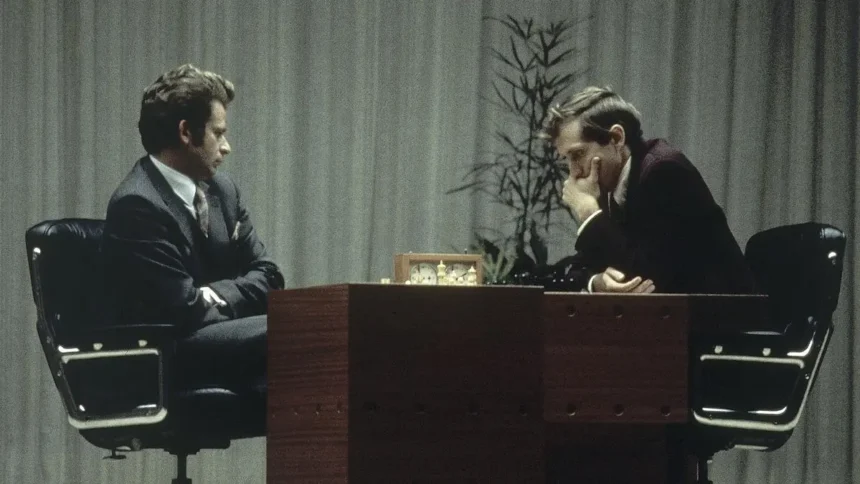
The Match of the Century: Fischer vs Spassky, 1972
“Our chess kingdom does not have borders.” — Boris Spassky
At the opening ceremony in Reykjavík on July 1, 1972, world champion Boris Spassky was present, the organizers were ready, and the international press had arrived. Bobby Fischer was still in New York. The American challenger had not confirmed when he would travel, even though the event was supposed to be getting underway.
That absence captured the uncertainty surrounding Fischer vs Spassky before a single move was played. The match had already become more than a contest for the world title. At the height of the Cold War, an American challenger was trying to break a Soviet championship run that had lasted since 1948. The contest was widely treated as the Cold War condensed onto sixty-four squares.
It almost collapsed before Game 1. Fischer objected to the financial terms and other arrangements, while Spassky and the Icelandic organizers waited for an answer. A personal call from U.S. National Security Adviser Henry Kissinger and a last-minute contribution from British financier Jim Slater helped keep Fischer vs Spassky alive. Even after Fischer arrived, the problems were far from over.
Table of Contents
- The World Before Reykjavík — Why This Match Mattered
- Fischer’s Road to the Match
- The Rivalry Before 1972
- The Match Almost Didn’t Happen
- Match Format, Venue, and Stakes
- Game-by-Game Drama
- The Final Result
- Immediate Reactions
- The Chess Boom That Followed
- What Happened After — Fischer’s Fall
- Fischer’s Later Years and the 1992 Rematch
- Spassky’s Later Life
- Why It Is Still Called the Match of the Century
- Closing Reflection
1. The World Before Reykjavík — Why Fischer vs Spassky Mattered
The World Chess Championship had been under Soviet control for twenty-four consecutive years. Mikhail Botvinnik won the title in 1948, and every undisputed champion who followed before Reykjavík was also Soviet: Vasily Smyslov, Mikhail Tal, Tigran Petrosian, and Boris Spassky. Chess had become one of the areas in which the Soviet Union could point to sustained international success.
That dominance was supported by a chess culture far larger and more organized than anything available in the United States. Soviet players benefited from clubs, coaching, regular high-level competition, analytical support, and state institutions that treated chess as a serious competitive activity. The World Chess Hall of Fame notes that Fischer’s achievement was especially striking because he did not have state support comparable to that given to Soviet champions. Its 1972 Fischer-Spassky exhibition material gives useful context on that difference.
Fischer did receive help from the American chess community and later worked with grandmaster William Lombardy as his second in Reykjavík, so the popular image of a completely unsupported loner is too simple. Even so, there was no American equivalent of the Soviet system behind him. Much of his development came from intensive personal study and years of tournament play.
That contrast shaped the public story of Fischer vs Spassky. Newspapers could present the match as one exceptional American challenging an entire Soviet chess establishment. The reality was more complicated, but the image was powerful.
For broader context on the game’s development, The Sports Manual’s history of chess and its legends places Fischer vs Spassky within the wider story of world chess.
2. Fischer’s Road to the Match
Bobby Fischer had been a major figure in American chess long before 1972. He won his first U.S. Championship at 14 in the 1957–58 event and became a grandmaster in 1958 at 15 years and six months, making him the youngest grandmaster in history at that time. The U.S. Chess Federation’s biographical account of Fischer records both milestones.
His run through the 1971 Candidates matches was even more impressive. Fischer defeated Soviet grandmaster Mark Taimanov 6–0 in the quarterfinal and Denmark’s Bent Larsen 6–0 in the semifinal. In the final, former world champion Tigran Petrosian stopped Fischer’s long winning streak but still lost the match 6½–2½. FIDE’s profile of Bobby Fischer confirms those scores.
Those results changed expectations around Fischer vs Spassky. Taimanov, Larsen, and Petrosian were established elite players, yet Fischer had gone through the Candidates with a level of dominance rarely seen at that stage of a world championship cycle.
By the July 1972 FIDE rating list, Fischer stood at 2785 and Spassky at 2660, a 125-point gap between the world’s top two players. Fischer arrived as the higher-rated player and the stronger recent performer.
There was still one important problem: he had never beaten Spassky.
3. Fischer vs Spassky Before 1972
Before the world championship, Fischer and Spassky had met five times in tournament play. Spassky had won three games and drawn the other two. Fischer therefore entered the biggest match of his career without a single previous victory over the champion.
That record mattered because Spassky was not a weak titleholder. He had defeated Tigran Petrosian in 1969 to become world champion and was known for being able to handle many different kinds of positions. He could attack, defend, play strategically, and adjust his style to the demands of a game.
FIDE later described Spassky as a genuinely universal player, especially strong in complex middlegames. That versatility made Fischer vs Spassky difficult to predict despite Fischer’s rating advantage and exceptional Candidates run.
Fischer also respected Spassky’s strength. In the apology he issued after arriving late in Reykjavík, Fischer said that his dispute had not been with Spassky and that he admired him as a player. The distinction is important because the political story can sometimes overshadow the fact that Fischer was facing an outstanding world champion.
4. The Match Almost Didn’t Happen
The negotiations surrounding Fischer vs Spassky became major news before the chess began. Reykjavík had agreed to host the championship with a prize fund of $125,000, already unusually large for professional chess, but Fischer remained dissatisfied with the financial arrangements and wanted additional revenue from the event.
He stayed in the United States as the opening approached and missed the July 1 ceremony, where the drawing of colors was supposed to take place. FIDE president Max Euwe postponed the start, while Spassky and the Soviet delegation protested the delay.
Henry Kissinger, then President Richard Nixon’s national security adviser, telephoned Fischer and encouraged him to go to Iceland and play. The World Chess Hall of Fame confirms the intervention in its account of chess and the American presidency.
British investment banker Jim Slater then contributed £50,000 of his own money, effectively doubling the prize fund to $250,000. With the financial issue eased and pressure mounting, Fischer finally flew to Iceland.
His arrival did not immediately settle matters. Spassky demanded an apology for the delay, and Fischer eventually issued one. The episode placed both players under pressure before Game 1 had even begun.
The background to the dispute is covered in Chess.com’s Match of the Century and Jaques London’s history of Fischer vs Spassky 1972.
5. Fischer vs Spassky: Match Format, Venue, and Stakes
The championship was scheduled as a best-of-24 match. A win counted as one point and a draw as half a point. Fischer needed 12½ points to become champion, while a 12–12 tie would allow Spassky to retain the title.
The games were played at Laugardalshöll in Reykjavík. After the delays, Game 1 began on July 11, and the match continued until September 1, 1972.
The format gave Spassky an important advantage because Fischer had to finish ahead rather than merely draw level. At the same time, Fischer vs Spassky was attracting an audience far beyond established chess circles. Disputes over cameras, playing conditions, scheduling, and money were now being reported alongside the games themselves.
6. Fischer vs Spassky: The Game-by-Game Drama
Game 1 reached an endgame that was widely considered drawable. Fischer then played 29…Bxh2, taking a pawn with his bishop and allowing the piece to become trapped. Spassky turned the mistake into a long technical win and took a 1–0 lead.
Game 2 produced no chess at all. Fischer objected to the television cameras in the playing hall and failed to appear. He was forfeited, putting Spassky 2–0 ahead and bringing Fischer vs Spassky close to collapse for a second time.
Game 3 became the turning point. To keep Fischer in the match, it was played in a small room away from the main stage and television cameras. Spassky agreed to the unusual arrangement, and Fischer responded with his best performance of the match to that point. Playing Black, he introduced the surprising 11…Nh5 in a Benoni structure and won after 41 moves. It was his first career victory over Spassky.
Game 4 was drawn, and Fischer won Game 5 to level the score at 2½–2½. The championship had effectively started again.
Game 6 then became the most celebrated game of Fischer vs Spassky. Fischer was famous for opening with 1.e4, but this time he began with 1.c4 and entered a Queen’s Gambit Declined. The choice took the game away from the preparation Spassky’s team expected, and Fischer gradually built a powerful positional advantage.
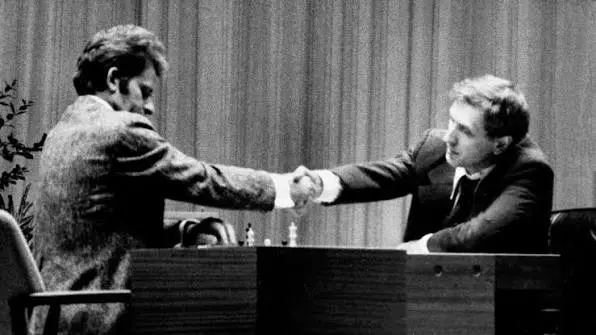
Spassky resigned after 41 moves. He then stood and joined the audience in applauding Fischer, a gesture confirmed by contemporary accounts and later histories of the match.
Fischer reportedly reacted by saying:
“Did you see that? That was class.” — Bobby Fischer
Grandmaster Miguel Najdorf offered an equally memorable description of the game:
“Like a symphony.” — Miguel Najdorf
The applause became one of the enduring images of Fischer vs Spassky because it showed Spassky acknowledging an exceptional performance despite the enormous pressure surrounding the championship.
Fischer now led 3½–2½. He went on to win Games 8 and 10. Spassky responded by winning Game 11, but Fischer restored his advantage with a remarkable victory in Game 13. Games 14 through 20 were all drawn, leaving Spassky with too little time to recover.
Game 21 began on August 31 and was adjourned after 40 moves. Spassky was in a difficult position and sealed his next move, but the game was never resumed. On September 1, he telephoned chief arbiter Lothar Schmid and resigned.
The full sequence can be followed in Chess.com’s Fischer vs Spassky World Championship review.
7. The Final Result
Fischer won the match 12½–8½. He scored seven wins over the board, Spassky won two games over the board and received one point from Fischer’s Game 2 forfeit, and eleven games were drawn.
The victory made Fischer the 11th World Chess Champion and the first American to win the official world title. It also ended twenty-four consecutive years of Soviet control of the championship.
HISTORY’s account of Bobby Fischer winning the World Chess Championship places Fischer vs Spassky directly in the political and sporting context of 1972. The final score also completed a remarkable turnaround after Fischer had fallen two points behind at the start of Fischer vs Spassky.
8. Immediate Reactions
Fischer vs Spassky had already received extraordinary international coverage, and Fischer’s victory made the result major news well beyond the normal chess press. Newspapers followed the games, television audiences watched updates, and people who had rarely paid attention to competitive chess suddenly knew the names of openings, players, and even individual games.
The result was difficult for the Soviet chess establishment. Its players had held the title since 1948, and chess success carried real prestige. Spassky returned to a cold reception, according to later accounts, although the Soviet response was more complex than the simple idea of a political humiliation.
Spassky’s conduct during the match remained a major part of his reputation. His applause after Game 6 was repeatedly cited as an example of sportsmanship, while Fischer himself called him a “true sportsman.”
Fischer vs Spassky produced a clear winner, but the match also strengthened respect for the champion who had lost. Spassky’s ability to remain composed through weeks of disputes became an important part of how the contest was remembered.
9. The Chess Boom That Followed
The effect of Fischer vs Spassky was visible quickly. Chess had already been gaining attention during Fischer’s rise, but Reykjavík pushed it into mainstream culture in the United States and parts of Western Europe.
Contemporary reports described rising sales of chess sets, clocks, and instructional books. Fischer’s own Bobby Fischer Teaches Chess had sold modestly before the championship, but chess historian Edward Winter records that it was reprinted eight times in 1972 and sold several hundred thousand copies that year.
Britain also experienced a significant increase in chess activity. The English Chess Federation’s history of the British Chess Federation credits the worldwide publicity from Fischer vs Spassky with having a major impact, including increased sponsorship.
That boom helped create conditions for a strong generation of English players. By the 1980s, England was one of the world’s leading chess nations and won silver behind the Soviet Union at the 1984, 1986, and 1988 Chess Olympiads. The 1972 match was not the only reason for that success, but it was an important part of the growth that preceded it.
For chess, the larger lesson was clear. A world championship could attract a mass audience when strong personalities, high stakes, and an understandable story came together.
10. What Happened After — Fischer’s Fall
Fischer returned to the United States as an international celebrity, but he largely resisted the commercial opportunities that followed. More importantly, he stopped playing competitive chess.
The next championship cycle produced Anatoly Karpov as his challenger for 1975. Fischer wanted major changes to the match format. He proposed that the championship continue until one player won ten games, with draws not counting and no fixed limit on the number of games.
The most disputed condition was his 9–9 rule. If both players reached nine wins, Fischer wanted the match declared drawn and the defending champion to keep the title. FIDE eventually accepted the unlimited, first-to-ten-wins format but rejected the 9–9 condition.
Fischer refused to compromise. When the deadline passed without his agreement to play, Karpov was declared World Champion by default on April 3, 1975.
The contrast with Fischer vs Spassky was significant. In 1972, disputes had delayed the championship but did not prevent it. Three years later, there was no match at all, and the unresolved 1975 dispute became an important part of the aftermath of Fischer vs Spassky.
The abandoned contest remains one of chess history’s great unanswered questions. Chessentials’ account of the proposed Fischer-Karpov 1975 World Championship explains the conditions and the breakdown in negotiations.
Fischer then disappeared from serious competitive chess for almost twenty years.
11. Fischer’s Later Years and the 1992 Rematch
Fischer finally returned to competition in 1992, again facing Boris Spassky. The event was promoted as a rematch, but it was not an official FIDE World Championship. It was played in the Federal Republic of Yugoslavia while the country was subject to international sanctions.
The U.S. government warned Fischer that taking part would violate sanctions. He played anyway and defeated Spassky 10–5 in decisive games, with 15 draws. Fischer was later indicted in the United States, and an arrest warrant was issued.
His later public life seriously damaged his reputation. Fischer made repeated antisemitic and extremist statements, along with other offensive remarks. Those statements are an unavoidable part of his public legacy, even though they are separate from judging his achievements at the chessboard.
Fischer was detained in Japan in 2004 during a dispute over his U.S. passport. Iceland later granted him citizenship, and he settled in the country where Fischer vs Spassky had made him world champion.
He died in Reykjavík on January 17, 2008, at the age of 64.

12. Spassky’s Later Life
Spassky remained active in high-level chess after 1972 and later moved to France, where he became a French citizen and represented the country internationally. He also faced Fischer again in the 1992 rematch.
His reputation remained closely connected to the way he handled Fischer vs Spassky. The Game 6 applause and his willingness to continue through repeated disputes became lasting examples of his sportsmanship.
Spassky returned to Russia in 2012 after decades in France. He died in Moscow on February 27, 2025, at the age of 88. The Associated Press report carried by NY1 on Boris Spassky’s death reviewed both his championship career and the lasting importance of Reykjavík.
Spassky once described his relationship with the game in simple terms:
“I feel at home at the chessboard.” — Boris Spassky
That line is especially appropriate for a player whose most famous match was so often presented through national rivalry.
13. Why Fischer vs Spassky Is Still Called the Match of the Century
More than fifty years later, the title “Match of the Century” still feels justified. Few chess events have combined sporting quality, political symbolism, strong personalities, controversy, and worldwide attention in the same way.
Fischer vs Spassky ended decades of Soviet control of the world title, produced several historic games, and demonstrated that chess could become a mainstream international story. Game 6 alone remains part of the standard history of great championship games, while the events surrounding Game 2 are still used as an example of how close the match came to falling apart.
The Cold War context made the championship larger, but it should not reduce the players to political symbols. Spassky was not simply a representative of the Soviet system, and Fischer was not literally fighting an entire country by himself. They were two exceptional grandmasters whose individual decisions shaped the contest.
That balance explains the lasting appeal of Fischer vs Spassky. The politics brought millions of people to the story, but the chess gave them a reason to remember it.
14. Closing Reflection
At the opening ceremony on July 1, 1972, Fischer’s absence made it reasonable to wonder whether the world championship would take place. Two months later, he had become world champion and had helped change the public position of chess in the United States and beyond.
Fischer vs Spassky remains compelling because the final score tells only part of the story. Fischer went 2–0 behind after a loss and a forfeit, won his first career game against Spassky in Game 3, produced a celebrated performance in Game 6, and gradually took control of the match.
Spassky lost his title, but his conduct under difficult circumstances remained part of his legacy. Fischer reached the highest point of his career, although the years that followed would make his personal story far more complicated.
The challenger’s place at the opening ceremony almost remained empty. Instead, Fischer vs Spassky became the championship that changed how much of the world looked at chess.
For more long-form sports history, rivalries, analysis, and stories, follow The Sports Manual on Instagram, WhatsApp, LinkedIn, X, and Medium.